Reagan, Genocide and Guatemala
By

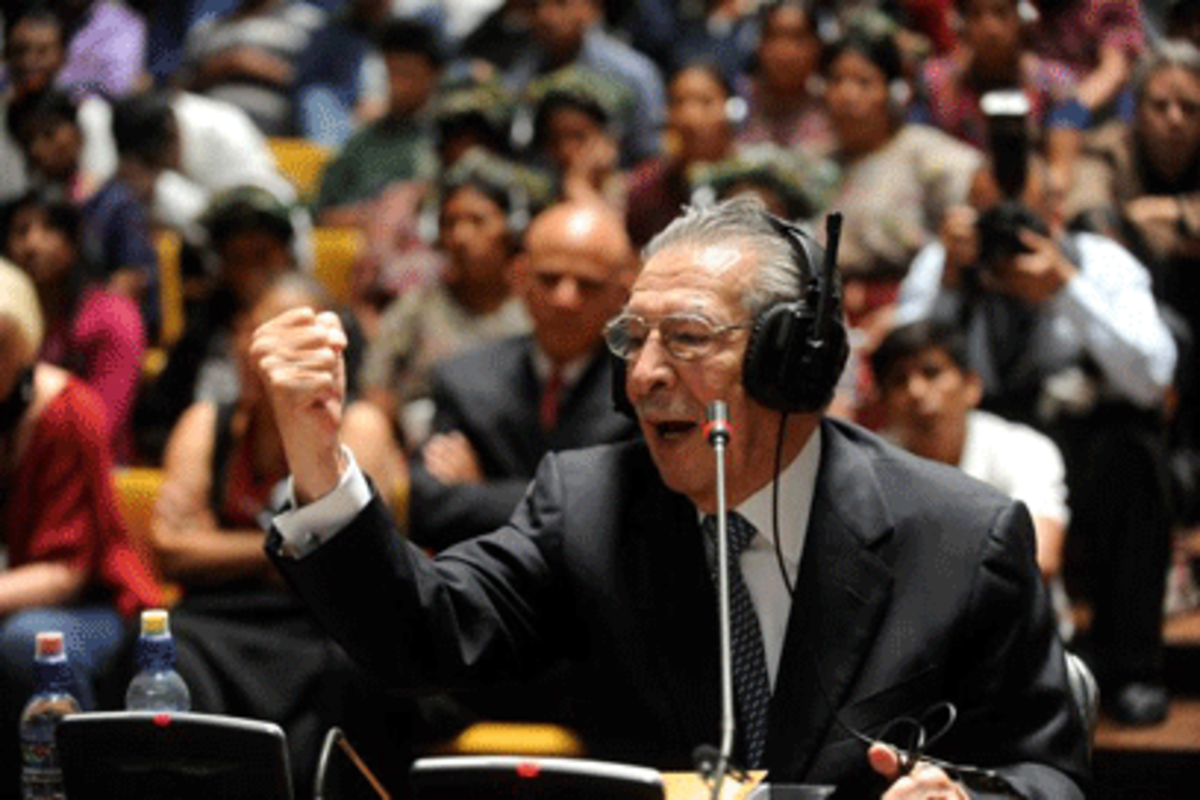
General Efrain Rios Montt
Now that a Guatemalan court has convicted General Efrain Rios Montt of genocide maybe we can better come to terms with the history of the early 1980s when the Reagan Administration was determined to vanquish communism in Central America. We should recall that General Montt was an ally in what President Reagan characterized as a life or death struggle against the spread of Soviet communism in the Western Hemisphere. (We might also want to remember that it was a CIA coup in Guatemala in 1954 that ousted from power the democratically elected leader, Jacobo Arbenz, and installed a tyrant, Colonel Castillo Armas, who set the stage for 30 years of dictatorial rule in that country.)
In the wake of the July 1979 Sandinista revolution in Nicaragua, the Reagan Administration insisted that the only way to resist communist influence in the Western Hemisphere was to bolster the militaries in El Salvador, Guatemala, and Honduras, while squeezing America’s ideological enemies in Nicaragua, Cuba, and Grenada. In 1982, at the time of General Montt’s military assault on the central highlands in Guatemala his actions were part of a wider set of U.S. strategic goals in Central America.
Reagan’s Ambassador to the United Nations, Jeane Kirkpatrick, was not exaggerating when she informed a group of conservative fundraisers that Central America had become “the most important place in the world for us.” The Administration designated the region the “front line” against communism and poured more money into Central America in a period of three years than it had over the previous thirty. Military assistance to El Salvador, for example, went from $5.9 million in fiscal year 1980 to $35.5 million in 1981, to $82 million the following year. During this same period, economic assistance went from $58.3 million in 1980 to $114 million in 1981, to $182.2 million in 1982. (Palermo, The Eighties, p. 37).
Long festering social and economic injustices had cultivated the conditions for the popular rebellions in Central America. For decades the concentration of wealth and land ownership, coexisting alongside pervasive rural poverty, had scarred these societies. In Rios Montt’s Guatemala, the top quarter of the population earned 67 percent of the nation’s wealth while the bottom quarter accounted for only 7 percent, and less than ten percent of farm workers owned any land.
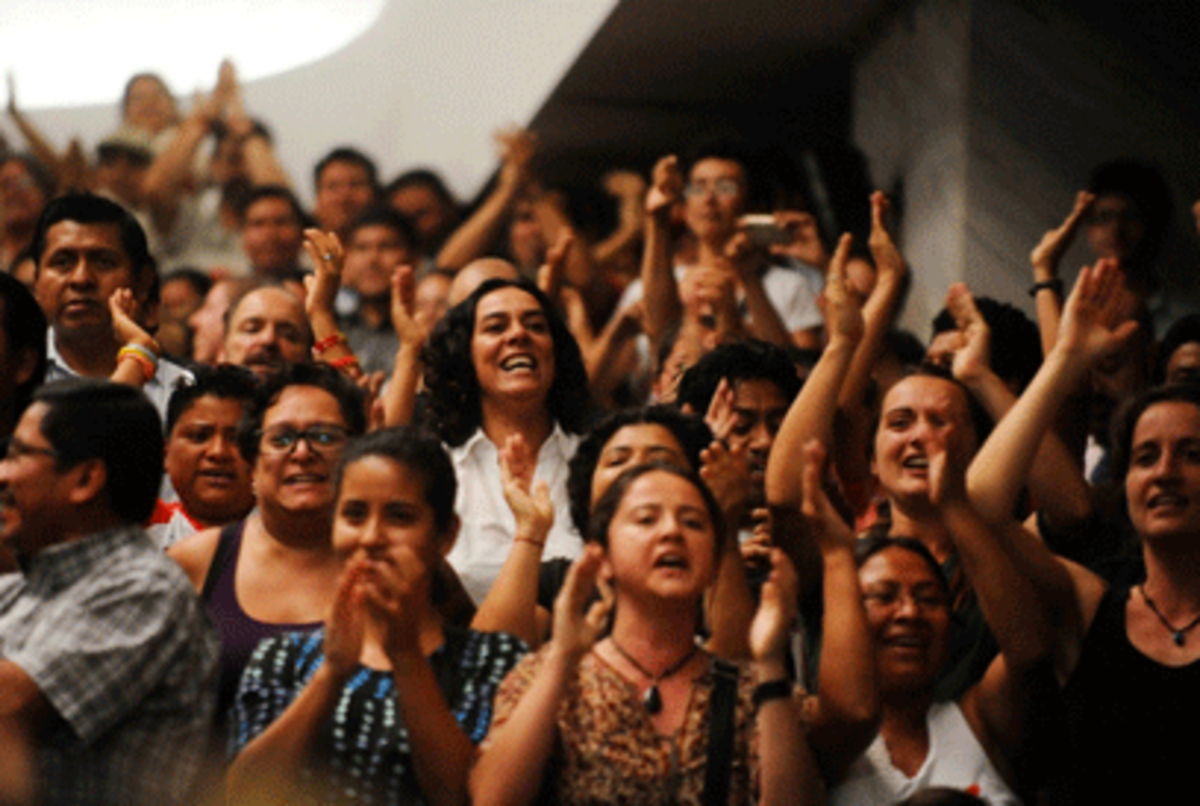
Guatemalans celebrating Montt’s sentencing. (Johan Ordonez, AFP)
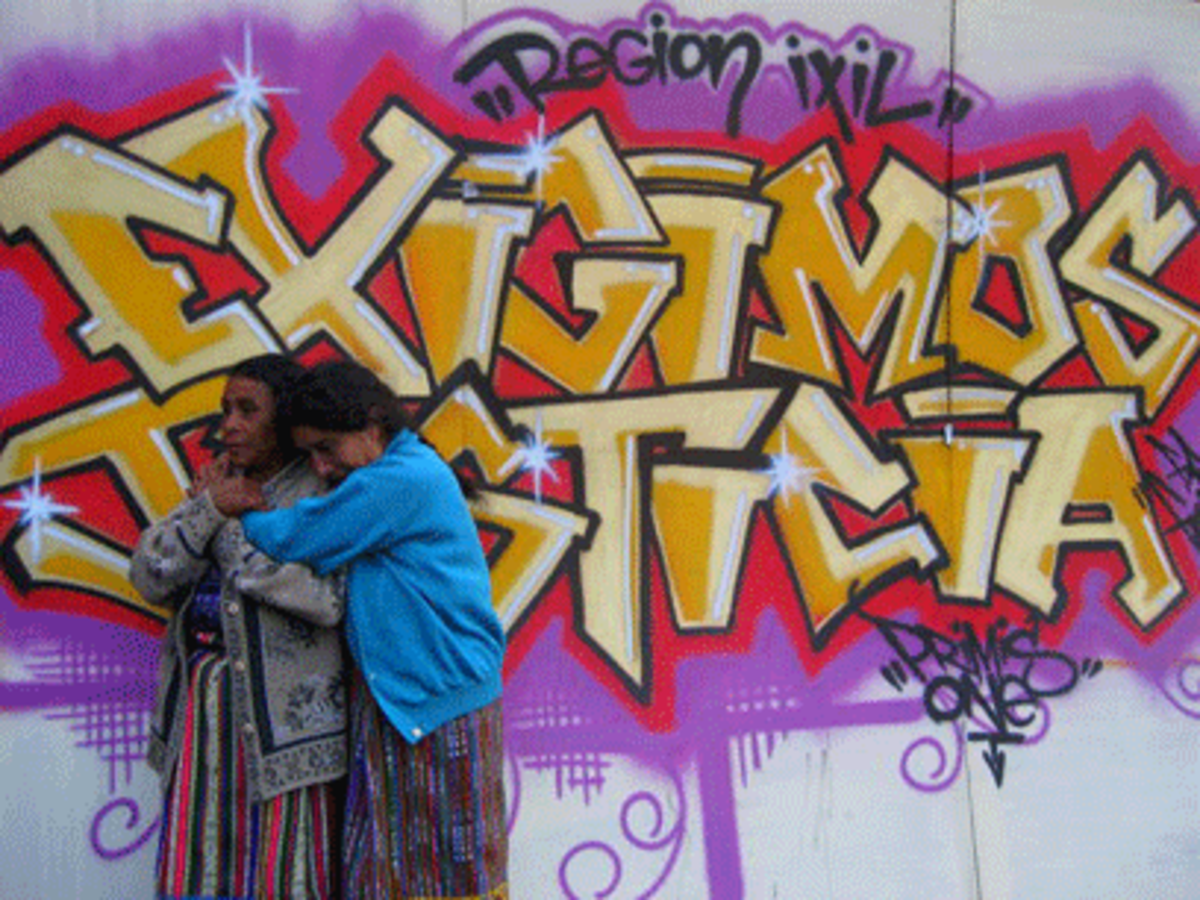
In March 1982, El Salvador held national elections that the Reagan Administration praised as “free and fair.” Some international observers were less persuaded, however, because the organized left and center-left had been effectively barred from participating. In Guatemala, the same month as the elections in El Salvador, General Montt came to power in a military coup. The most populated of the Central American states, Guatemala had also experienced a historic upswing in political opposition and armed resistance to oligarchic rule. General Montt sought to eliminate the base of support for the insurgency by wiping out as many as 400 Mayan villages in the country’s highlands and forcing people to relocate into areas of greater government control. As Montt’s “Victory 82″ scorched-earth campaign generated tens of thousands of refugees, international human rights organizations denounced the military assault. That’s when President Reagan told the press he believed human rights monitors had given General Montt “a bum rap.”
In Honduras, the U.S. supported a thinly veiled military dictatorship under General Gustavo Alvarez who established a new constitution in 1982. Honduras became the linchpin of the Administration’s Central America policies because it was the staging ground for the Contra war. Reagan appointed the career diplomat, John Negroponte, who had extensive counterinsurgency experience in Southeast Asia during the Vietnam War, to be his ambassador in Tegucigalpa. (Negroponte later served in the George W. Bush Administration as United Nations Ambassador, Ambassador to Iraq, and the first Director of National Intelligence.) General Alvarez worked closely with Negroponte to assist the Nicaraguan Contras, and like General Montt in Guatemala and the U.S.-backed government in El Salvador, was dedicated to ensuring that Honduras did not follow the path of Nicaragua.
 Although human rights and church groups reported that the Salvadoran government was working hand-in-glove with the death squads, the idea that “extremists” on both sides were equally responsible for the repression continued to dominate the mainstream debate in the United States. In late 1981, when reports surfaced that the U.S.-backed “Atlacatl Battalion” of the Salvadoran Army massacred peasants near the village of El Mozote, both the Salvadoran government and the Reagan Administration denied it happened. The “El Mozote massacre” had left 767 men, women, and children dead and human rights groups and church representatives gave an account of the atrocity relatively quickly. Reagan’s foreign policy officials did not want reports of human rights abuses by El Salvador’s security forces to move Congress to change course and discontinue aid to the Salvadoran military as it had done with Nicaragua when the Somoza regime clung to life. (Palermo, The Eighties, pp. 36-37)
At the time, of course, General Montt wasn’t doing anything all that different from what the death squads and paramilitaries were doing in El Salvador, or what the Nicaraguan contras (the remnants of Somoza’s National Guard) were doing on the border of Honduras and Nicaragua. Montt’s crimes were just one part of a larger counterinsurgency effort directed, financed, and implemented by the United States.
In early 1983, Reagan told a joint session of Congress: “El Salvador is nearer to Texas than Texas is to Massachusetts [and] Nicaragua is just as close to Miami, San Antonio, San Diego, and Tucson as those cities are from Washington,” implying that geographical proximity could determine the power of Central American nations vis-à-vis the United States. Reagan further warned that if the United States could not defend its interests in Central America, “we cannot expect to prevail elsewhere. Our credibility would collapse, our alliances would crumble, and the safety of our homeland would be put in jeopardy.”
 The common purpose of “protecting” the U.S. “homeland” from the spread of communism in the hemisphere was why Reagan said he believed Montt had gotten a “bum rap” after international bodies, including Amnesty International and the United Nations, condemned his abysmal human rights record. I wonder what the Gipper would say today upon hearing the news that Montt has now been sentenced to 80 years in prison for genocide?
At the time he perpetrated his crimes, Montt was well known for being a right-wing Christian evangelical. He was known to go on television in Guatemala where he would talk about God and his providential mission to eliminate atheistic communism in Guatemala by any means necessary. Now that a Guatemalan court has convicted him of genocide we have a better idea what those means were.
Joseph Palermo
Joseph Palermo’s Blog
Joseph Palermo’s Blog
Sunday, 12 May 2013
